
Container Gardening
How to Improve Drainage in Plant Containers
Good container drainage depends on a clear exit for water, an appropriate potting mix, and sensible watering. Check the whole setup before adding gravel or repotting a struggling plant.
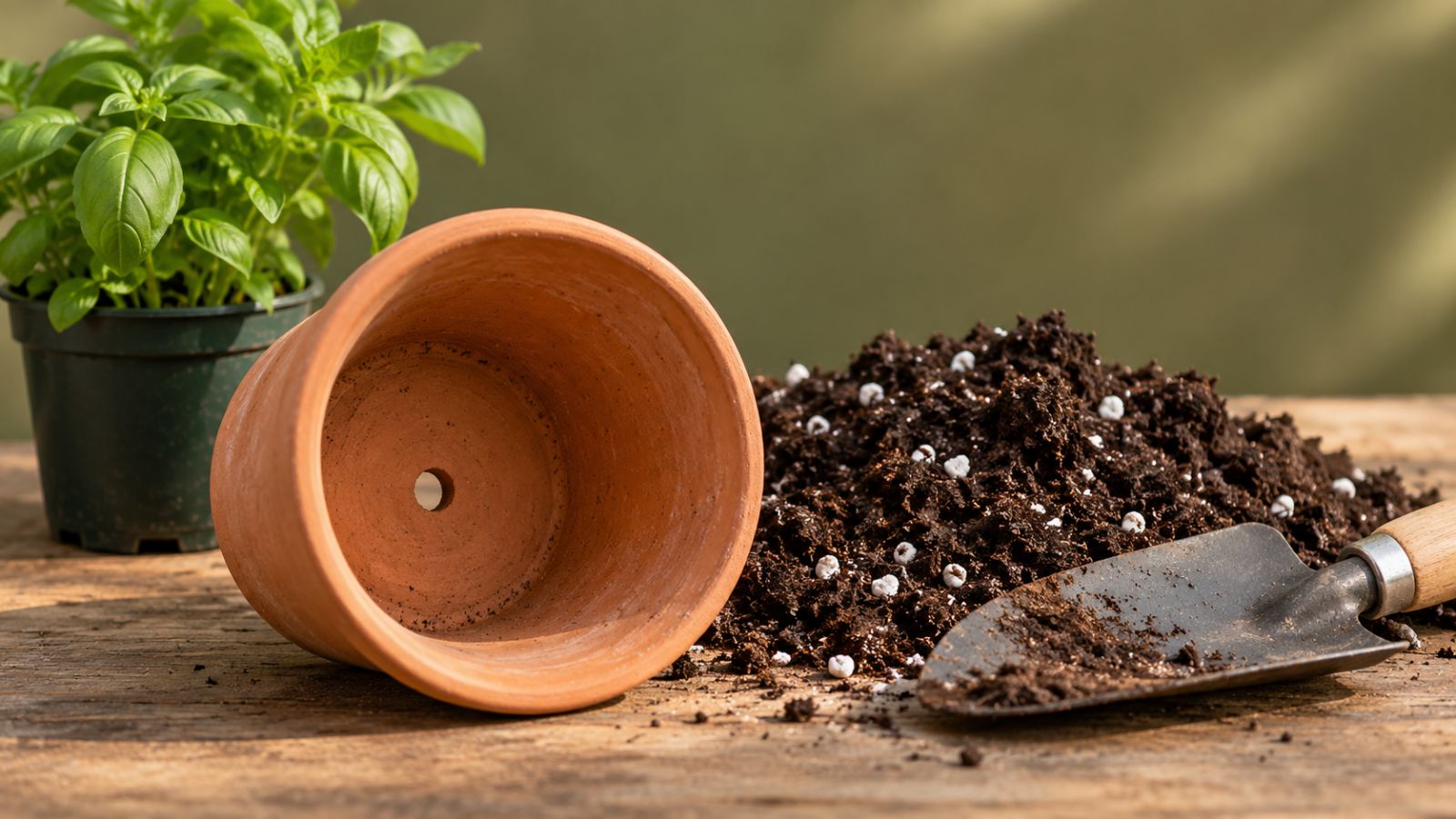
A drainage problem is not always a missing hole. Water may be trapped in a decorative outer pot, the medium may stay wet too long, or the plant may be watered again before it needs it. Check the complete path water takes: into the potting mix, through the root ball, out of the container, and away from the roots.
1. Give excess water somewhere to go
For most ordinary soil-grown container plants, start with a pot that has functioning drainage holes. Inspect its underside and remove obstructions without injuring roots. If you cannot safely modify a decorative container, use it as an outer cover around a removable nursery pot with drainage. Remove the inner pot for watering when practical, let it drain, and empty water retained in the cover.
Illinois Extension's container-drainage guide explains why holes and removable saucers matter. If the exit is blocked by the surface beneath a pot, consider suitable stable pot feet; Maryland Extension discusses this in its container-gardening guide. Do not balance a heavy pot on an improvised unstable stack.
2. Skip the gravel layer beneath the mix
Putting stones underneath the root-zone mix does not reliably solve poor drainage. Water can accumulate in the finer material above the coarse layer before moving through it. The layer also takes up space that could hold suitable growing medium. Use a functioning outlet and an appropriate mix instead. Illinois Extension describes this in its guidance on why gravel does not improve pot drainage.
A small piece of suitable mesh over an unusually large hole serves a different purpose: limiting loss of medium while allowing water through. It is not a deep drainage layer. Avoid sealing the opening with a tight plug. Maryland's container-planting guidance discusses covering drainage openings and filling pots without packing the medium hard.
3. Match the growing medium to the plant
Roots need both water and air in the spaces within their medium. Persistent saturation prevents those spaces from replenishing with air. For many container plants, a suitable commercial container mix is a more useful starting point than garden soil dug from a bed. Ingredient lists and product labels matter more than treating every bag labelled 'soil' as interchangeable. If an avocado develops pale leaves or wilts while its mix stays wet, our yellow avocado leaves guide explains what to check and when to seek help.
University of Maryland Extension's growing-media guide explains the roles of air spaces and moisture retention. Minnesota Extension also notes that heavy garden soil can compact and restrict air and water movement in containers in its container-starting guidance.
Choose for the plant and system, not just the promise of 'faster drainage.' A moisture-loving vegetable and an orchid do not need the same substrate. Avoid improvising a universal sand, compost, or perlite recipe for every species. If the medium is unsuitable, plan a careful repot using species-appropriate guidance rather than repeatedly disturbing the roots to add small corrections.
4. Check whether the pot is oversized
A small root system in a much larger volume of wet medium can be difficult to manage. Bigger is not automatically better. Illinois Extension advises moving houseplants up modestly in pot size rather than overpotting in its houseplant setup guide. That is general houseplant advice, not a sizing formula for every tree, vegetable, or growing system.
5. Recheck watering and the outer container
Even a suitable pot and mix can remain too wet if water is added repeatedly without checking. Inspect saucers after rain as well as after watering. A covered plant may receive little rain, while an uncovered pot can collect it; neither should inherit the other's watering decision. Follow our check-before-watering routine.
After adjusting the setup, record what changed and observe whether the medium behaves differently. Do not call rapid runoff proof of success: water can leave around the sides without wetting a dry root ball evenly. Persistent wilt, smell, or decline deserves a closer assessment rather than another drainage gadget. Our leaf-mulch garden comparison makes a similar distinction: less surface pooling did not establish how quickly water drained below the roots.
A quick container audit
Can excess water leave the planted pot freely?
Can it collect around the roots inside a saucer or cover?
Is the mix appropriate for the plant and container?
Is pot size reasonable for the root system?
Are watering decisions based on checks rather than habit?
Keep the answers and the date of any change in your plant-growth record. That gives future care decisions a useful starting point.
About this guide
This is a research-based editorial guide, prepared with AI-assisted drafting and checked against the linked horticultural references. It does not report an original PlantPeepal growing trial or claim independent expert review.
Sources and further reading
- Research-based editorial guidance. AI-assisted drafting; no original growing trial or independent expert review is claimed.
- https://extension.illinois.edu/container-gardens/container-drainage-options
- https://extension.umd.edu/resource/growing-media-potting-soil-containers
- https://extension.umn.edu/about/our-stories/news/starting-your-garden-and-containers-off-right
- https://extension.umd.edu/resource/planting-vegetables-containers
- https://extension.illinois.edu/houseplants/get-started
- https://extension.umd.edu/resource/growing-vegetables-containers-and-salad-tables
- Featured image: AI-generated editorial illustration.